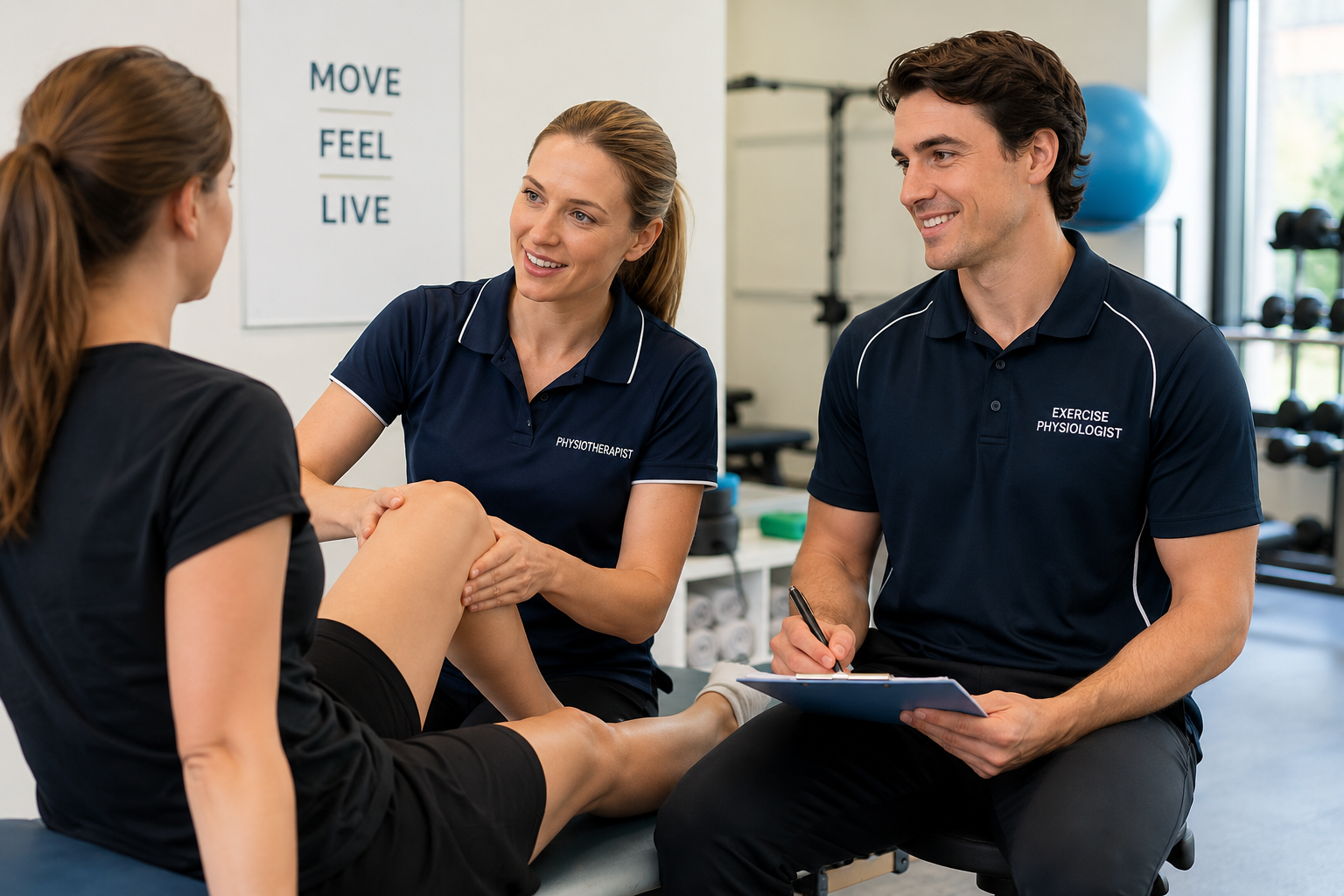
By MBXphys — Exercise Physiologists | mbxphys.com.au
Something went pop. Your back went out picking up a sock. You Googled your symptoms and now you’re convinced you have three different conditions. Or — on the other end of the spectrum — you’ve been cleared by your specialist, given the green light to exercise, and handed a referral to an allied health practitioner with absolutely no further guidance.
In all of these scenarios, the question is the same: physio or exercise physiologist?
Most people can’t answer that confidently. And honestly, that’s not their fault. Both professions have ‘physio’ somewhere in the vicinity of their title, both work in movement and health, and both can be accessed through Medicare and private health insurance. The differences are real and clinically significant — but nobody explains them clearly.
This post does exactly that. No jargon, no hedge, no ‘it depends’ non-answers. By the end, you’ll know exactly which profession you need, when, and why — and you’ll understand why the two work best as a team rather than in competition.
First, What’s the Difference?
The simplest way to frame it:
The One-Liner: Physio gets you back to zero. EP takes you past it.
But let’s go deeper than a one-liner.
What Does a Physiotherapist Do?
Physiotherapists are AHPRA-registered health professionals — meaning they’re regulated under the same national law as doctors, nurses, and dentists. They assess, diagnose, and treat conditions that affect movement and physical function. Their toolkit includes hands-on techniques: joint mobilisation, soft tissue massage, dry needling, and manual therapy, alongside exercise prescription and rehabilitation planning.
If something is acutely injured, actively painful, or structurally concerning — you don’t know what’s wrong, something snapped, or you’re recovering from surgery — a physiotherapist is your first call. They’re trained to diagnose, which is a scope of practice that exercise physiologists do not hold.
In Australia, physiotherapists complete a minimum four-year university degree and must be registered with AHPRA and the Physiotherapy Board of Australia to practise.
What Does an Exercise Physiologist Do?
Accredited Exercise Physiologists (AEPs) are allied health professionals governed by Exercise and Sports Science Australia (ESSA). They specialise in using exercise as a therapeutic intervention for the prevention and management of chronic disease, injury rehabilitation, and long-term functional improvement.
Where physiotherapists are hands-on, Exercise Physiologists are prescription-based. They don’t diagnose, they don’t use manual therapy — but they do something just as important: they write clinical exercise programs that are evidence-based, progressive, and tailored to your specific condition and goals.
The pathology domains covered by AEPs are broad: cardiovascular, metabolic, neurological, musculoskeletal, oncological, respiratory, mental health, and any condition for which evidence supports exercise as an effective intervention — which, as it turns out, is most of them.
Like physiotherapists, AEPs complete a minimum four-year university degree and are eligible to provide services under Medicare, private health insurance, NDIS, DVA, and WorkCover.
The Distinction: Exercise Physiologists don’t fix what’s broken. They build what’s left — and make sure breaking is less likely in the future.
When to See a Physiotherapist
The clearest indicator: you have a new, unexplained, or acute problem that hasn’t been assessed and you’re not sure what’s wrong.
• Something went pop and you don’t know what it was
• You’re in acute pain and need a diagnosis
• You’ve had a recent injury — sprain, strain, fracture, post-surgical — and need early rehabilitation
• You have restricted range of motion or joint issues that need hands-on assessment and treatment
• You tore something at the gym because you skipped the warm-up. Again.
• Your back ‘went out’ picking up a sock and you need someone to tell you what actually happened
Physiotherapists are also your first port of call for complex neurological conditions, post-operative care, and any situation where a formal clinical diagnosis is required before further treatment can begin.
Important note: Physiotherapists are the only allied health profession in this comparison who are qualified to diagnose musculoskeletal conditions. If you’re unsure whether your problem needs a diagnosis, start with physio.
When to See an Exercise Physiologist
The clearest indicator: something has been assessed, the acute phase has passed, or you have a chronic condition that requires long-term management through structured exercise.
• Your physio cleared you and said ‘go strengthen it’ — but didn’t tell you how
• Your GP said ‘try to exercise more’ and you need that turned into an actual program
• You have a chronic condition — diabetes, cardiovascular disease, osteoporosis, cancer, MS, mental health — that is managed in part through exercise
• Your balance is deteriorating and you refuse to admit it’s an age thing (it is, and we can fix it)
• You want to be unfairly strong for your age
• You’re 70 and your dad is 90 and he just outlifted you
Exercise Physiologists are also the profession of choice when you have multiple comorbidities and need someone who understands how to programme exercise safely around complex medical pictures. An AEP will communicate with your GP, specialist, and any other treating practitioners — we don’t work in isolation.
The Translation: If your GP said ‘try to exercise more’ — that’s a referral in disguise. An AEP turns vague advice into a clinical program with sets, reps, and a reason.
Medicare: How Does Funding Work for Each?
Both physiotherapists and exercise physiologists can be accessed through the Medicare Chronic Disease Management (CDM) plan — formerly the Enhanced Primary Care plan.
The Basics
To access Medicare-subsidised EP sessions, you need a chronic condition that has been, or is likely to be, present for six months or more. Your GP prepares a CDM Plan and refers you specifically to an Accredited Exercise Physiologist under MBS item 10953. The Medicare rebate as of July 2025 is $61.80 per individual session.
You can access up to 5 individual allied health sessions per year under a CDM plan. If you live with type 2 diabetes, you may also qualify for up to 8 group Exercise Physiology sessions annually.
Physiotherapy sessions are accessed through the same CDM framework but under different item numbers. Both professions are also recognised by private health insurers, NDIS, DVA, and WorkCover — the specifics depend on your plan and situation.
The Numbers: Over 8.2 million allied health services are claimed each year through chronic disease management plans. Exercise Physiology accounts for 351,000+ of those sessions — and remains significantly under-utilised given Australia’s chronic disease burden.
A Practical Note on Referrals
You don’t need a referral to see either a physiotherapist or an exercise physiologist privately. A referral is required if you want to access Medicare subsidies through a CDM plan. If you’re unsure whether you qualify, the easiest first step is a conversation with your GP.
The Overlap — and Why It’s a Feature, Not a Bug
Here’s the thing: physiotherapy and exercise physiology are not in competition. They’re complementary — and the best health outcomes happen when both are involved at the right time.
The typical pathway for a musculoskeletal injury looks something like this:
• Injury occurs → Physio diagnoses and manages acute phase
• Pain resolves, movement restored → Physio clears for progressive loading
• EP takes over → Progressive resistance training, functional rehabilitation, return to sport or work
• Long-term → EP manages ongoing strength, conditioning, and chronic disease prevention
This isn’t a handoff — it’s a handover. And when both practitioners are communicating (which they should be), the client gets seamless, coordinated care rather than starting from scratch every time they walk into a new clinic.
At MBXphys, we work alongside physiotherapists, GPs, and specialists regularly. Our role is not to replace other practitioners — it’s to fill the gap between clinical clearance and long-term function. That gap is where most people fall through the cracks.
How They Work Together: The physio fixes what’s broken. The EP makes sure it doesn’t break again — and builds everything around it stronger in the process.
Why Most People Have Never Heard of Exercise Physiology
Exercise Physiology is, relatively speaking, a newer profession in the Australian allied health landscape. Physiotherapy has been around since the early 20th century and has the name recognition to show for it. Exercise Physiology as a formalised clinical profession — with university-level training, professional accreditation, and Medicare recognition — is a more recent development.
As a result, many Australians go their entire lives without ever being referred to an AEP, even when their conditions would directly benefit from EP intervention. Physical inactivity costs the Australian economy an estimated $805 million per year. Despite the overwhelming evidence underpinning the effectiveness of exercise physiology for chronic disease management, clinical exercise interventions are still not part of routine care for most Australians.
That’s a system problem — and it’s one we’re trying to chip away at one referral at a time.
The conditions that respond well to exercise physiology are not rare or niche. They include:
• Type 2 diabetes and metabolic syndrome
• Cardiovascular disease and hypertension
• Osteoporosis and osteopenia
• Osteoarthritis and chronic musculoskeletal pain
• Multiple sclerosis and other neurological conditions
• Cancer — during and after treatment
• Mental health conditions including depression and anxiety
• Obesity and weight management
• Chronic obstructive pulmonary disease (COPD)
• Sarcopenia and age-related muscle loss
If you or someone you know is living with any of these conditions and hasn’t been referred to an EP — it’s worth raising with your GP.
The ‘Just Exercise More’ Problem
One of the most common — and least useful — pieces of advice given to Australians with chronic conditions is to ‘try to exercise more.’
It’s not wrong. Exercise is one of the most powerful therapeutic interventions available for virtually every chronic condition on the list above. The evidence is unambiguous on this. But ‘try to exercise more’ is not a prescription. It has no dose, no frequency, no intensity, no progression, no safety parameters, and no mechanism for monitoring whether it’s working.
It’s the equivalent of telling someone with high blood pressure to ‘try to eat better.’ Directionally correct. Clinically useless.
An AEP takes that advice and translates it into a clinical exercise program: specific exercises, specific loads, specific progression, built around your condition, your comorbidities, your goals, and your life. It’s monitored, adjusted, and progressed over time — not handed to you on a sheet of paper and left to gather dust.
The Core Argument: Exercise is medicine. But medicine needs a prescription. That’s what Exercise Physiologists provide.
What Happens in an EP Session?
If you’ve never seen an Exercise Physiologist before, here’s what to expect.
Initial Assessment
Your first session is an assessment. We’ll go through your medical history, any diagnoses, current medications, previous injuries, movement history, and goals. We’ll conduct a functional assessment — which may include strength testing, balance assessment, movement screening, and cardiovascular baseline testing depending on your situation.
This takes time. It’s supposed to. We’re building a clinical picture, not just asking if you’ve exercised before.
Program Design
Based on the assessment, we design a program. This isn’t a generic gym program with your name at the top. It’s a clinical exercise prescription — specific to your condition, your capacity, your goals, and the evidence base for your particular health situation.
If you have osteoporosis, the program will include axial loading and compound movements because that’s what the evidence says is required for bone density. If you have type 2 diabetes, we’ll factor in glycaemic response to exercise and timing of sessions relative to meals. If you have multiple sclerosis, we’ll programme around fatigue management and heat sensitivity. The prescription changes. The clinical rigour doesn’t.
Ongoing Sessions
Every session is progressive — load increases, complexity builds, and the program evolves as you do. We monitor, adjust, and communicate with your other treating practitioners as required. If something isn’t working, we change it. If you hit a milestone, we raise the bar.
This is not a gym. It’s clinical exercise. The difference matters.
A Note to GPs and Referring Practitioners
If you’re reading this as a GP or allied health practitioner — thank you for being curious about EP. The referral pathway is straightforward and the clinical outcomes for appropriate patients are well-supported by evidence.
The Chronic Disease Management plan (MBS item 10953) allows you to refer patients with chronic conditions to an Accredited Exercise Physiologist for subsidised individual sessions. Group diabetes sessions are also available under separate item numbers.
The conditions that respond best to EP referral include — but are not limited to — type 2 diabetes, cardiovascular disease, osteoporosis, chronic musculoskeletal conditions, neurological conditions, cancer rehabilitation, mental health, and sarcopenia in older adults.
If you’re unsure whether a patient is appropriate for EP referral, the answer is almost always to try. AEPs are trained to assess what they can and cannot safely manage, and will refer back or flag concerns where appropriate. We are not a replacement for medical care — we are a complement to it.
For Referrers: The gap between medical clearance and long-term function is where most patients fall through. Exercise Physiologists fill that gap.
The Bottom Line
Physio and exercise physiology are not the same thing. They’re not interchangeable. And you don’t have to choose one — the best outcomes happen when both are part of your care team.
The simple rule:
• Something is new, painful, or needs diagnosing → Physio first
• You’ve been cleared, you have a chronic condition, or you want to be stronger and more functional long-term → EP
• Ideally → Both, at the right time, talking to each other
If you’ve been told to ‘exercise more’ and left to figure it out, if you’ve been cleared by a physio and don’t know what to do next, or if you just want to be the 90-year-old who embarrasses your kids — we can help with all of that.
Work With MBXphys: MBXphys is an Exercise Physiology practice based in Australia. If you’d like to discuss whether EP is right for you, visit mbxphys.com.au or speak with your GP about a CDM referral.
References
1. Australian Physiotherapy Association (2024). Differences between a physiotherapist and an exercise physiologist. australian.physio
2. Exercise & Sports Science Australia (ESSA). ESSA for an Active Nation: Medicare Benefits Schedule. activenation.org.au/mbs
3. Flinders University Sport and Fitness. Exercise Physiology Services — ESSA Definition of AEPs. flindersuniversitysportandfitness.com.au
4. Movement Therapy EP (2025). Is Clinical Exercise Physiology Covered by Medicare in Australia? movement-therapy.com.au. MBS item 10953 rebate $61.80 as of July 2025.
5. The Movement EP (2026). Exercise Physiology in Australia: Care and Funding Guide. themovementep.com.au
6. Global Health Education Australia (2025). Exercise physiologist vs physiotherapist. globalhealtheducation.com
7. ESSA (2020). Position statement on exercise and chronic obstructive pulmonary disease. Journal of Science and Medicine in Sport. doi:10.1016/j.jsams.2020.08.013
8. Hartwell Physio (2024). Difference between Physio and Exercise Physiology. hartwellphysio.com.au
9. DAAR Services (2025). Exercise Physiologist vs Physiotherapist: Key Differences Explained. blog.daar.com.au
10. Healthstin (2021). Exercise Physiologist vs Physiotherapist: Which one should you see? healthstin.com.au